Posted: 01-Apr-2018 | Category: General
Mains Hookup Socket
The first phase was to install the hookup socket. I did this early in the build as I needed to get power into the van so I could work on it in the rain. Cutting the hole for the socket was also the first hole to be cut - an easy way into the task of cutting holes for windows.
I worked out the position inside and drilled a small hole through so I could mark out the outside.
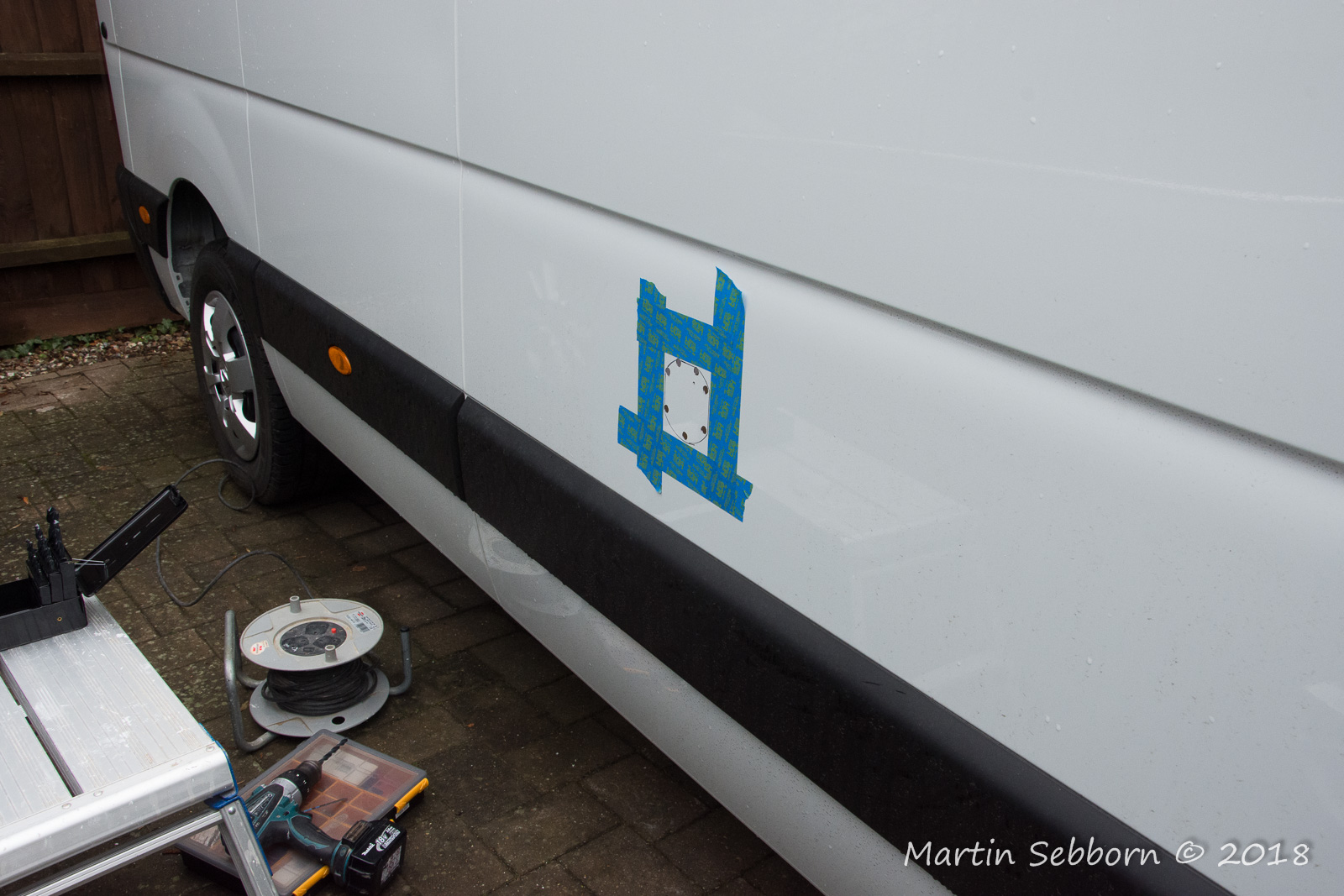
I drew round the socket box, then drilled a number of pilot holes, then using good quality blades in a jigsaw, cut out the hole. Don't do what I did and cut inside the lne - make sure you cut on the line otherwise you have to file the hole out to get the socket to fit.

The edges of the hole were deburred and then painted in a couple of coats of red oxide.

The socket was fixed using stainless steel screws.


Posted: 02-Apr-2018 | Category: General
Shelf above cab
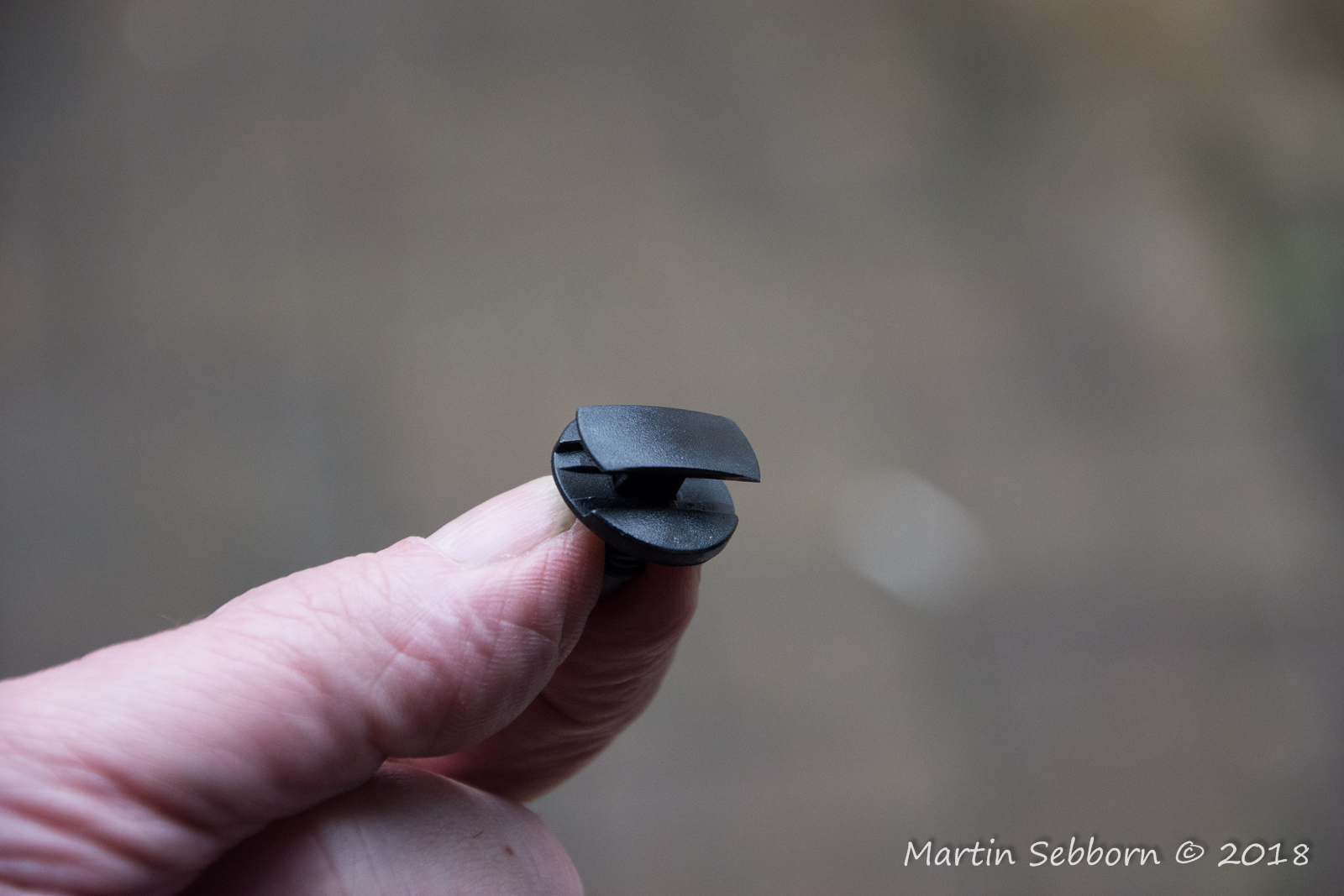
One of the downsides of choosing the Master is taht there is less info online than for say the Ducato. Removing the plastic liner for the top shelf is a case in point - it took a few minutes to work out how the clips worked - see photos below:

Posted: 03-Apr-2018 | Category: General
Water - Planning
From our point of view, it is essential to understand how you intend to use the van, and determine the water needs. Basically you potentially want water for:
- Drinking
- Toilet flushing
- Washing up
- Washing yourself and teeth cleaning
- Showering
In our case, we will only ever wild camp for a few days maximum, and will then hit a camp site for a few days, even on long trips. So we do not intend to install a shower in the van. Having spoken to a number of people who have rented motorhomes, they all state that they never used the shower......
The WC is essential for wild camping, but is unlikely to be used when on a site.
So, consideration is given to the "types" of water:
Fresh Water
Used for drinking, washing, washing-up and toilet flushing.
Carrying enough water to wild camp for a few days is essential for us. We had much discussion about whether we should just carry large water containers as we do in the T4, but concerns about storage space have pushed the decision to having an under-slung fresh water tank.
We intend to fit a sink and a basin in the bathroom.
Toilet flushing is altogether trickier. Having decided on under-slung tanks, our first thoughts were to use that water to flush the toilet. However, on researching and seeking answers on the forums, most preferred having a WC with its own separate water. The following are the arguments for both approaches:
WC with own tank
There seem to be two main arguments:
- Having a separate WC supply preserves the fresh water supply, making it last longer
- If you are going away for just a night or two , you don't need to fill the "main" tank
WC reliant on van water tank
This is the less popular approach, the main arguments are:
- No need to fill a second tank when on a trip
- No need for an extra external filler
- One less tank to regularly drain down|
Originally we thought we would go for a toilet fed from the main tank on the basis that if we were away for just a night or two, we are very unlikely to wild camp - there is nowhere within reach of where we live that we can legally do so, so we are likely to be staying on a site and not be using the van WC.
However, when we thought more about it the advantages of having a toilet with its own supply made more sense. To keep things simple, we went for a manual pumped toilet - the Thetford CW234CW.
Grey (Waste) Water
Some method of collecting the waste water from washing and washing up is needed - you can't just let it pour out on the ground! The waste water needs gravity to get it to a tank, so an under-slung grey water tank makes most sense.
Soil
The planned WC has a removeable cassette for disposal of soil waste....
Posted: 04-Apr-2018 | Category: General
Mocking up the space
As it is quite hard to envisage the van's space, we used some protective sheets from Wickes to mockup the washroom, cupboards and rear "shed" The sheets were on offer over the bank holiday and will be subsequently used to protect the van floor during the build.
We are going for a storage space at the very rear, a rear washroom and then a tall cupboard to house the fridge. The photos show the mock up from various angles.


Posted: 10-Apr-2018 | Category: General
Front seats
The van was supplied with a double passenger seat which doesn't suit our needs, so we looked into various options for changing the seats. It is surprisinly difficult to find aftermarket seats - in the end we found a company in Cannock that import various German seats. However, there is only one choice for the Master, those made by Sportscraft. We visited and liked the seats, but two things worked against us. First, there is a very limited choice of fabrics available for the Sportscraft seats, and secondly, for the passenger seat we needed to source a "seat box".
We pondered this for a while, and meanwhile had come across someone selling "new" Renault Master single passenger seats. We also spoke to a number of vehicle upholsterers about updating the Renault seats, and given this would give us a better choice of fabrics (to match the seat/bed) and work out cheaper overall, this is the route we have gone.
So the ebay seat was bought, and shipped to us. The existing double seat is easy to remove - 5 bolts in the base have to be undone and removed, and the seatbelt disconnected from the seat. It then simply lifts out. We sold the double seat on ebay...
The single seat obviously has a different footprint, which requires a new cutout in the rubber mat, and leaves two spaces which will be covered when we install mats. Under the new cutout there is a "non-removable" screw in the thread - I had to cut a slot in it and then use a small cold chisel to drift it out.
The photos below show the old double seat, and then the new single seat!
 The original double seat
 Sorting the floor
 The new single seat
Posted: 14-Apr-2018 | Category: General
Electrics started
The next phase was to install a consumer unit. The plan is to have all the electrics located under the bed / sofa - so a ply panel was fixed against the wall for the electrical items to be installed.
I wanted a plastic cased consumer unit - these are increasingly difficult to find now that the new UK electrical regulations require the installation of a metal cased units. A few of the specialist conversion suppliers offer such units, but they are expensive and so searched on eBay and came up with a decent unit for a sensible price, and the supplier fitted the breakers (MCBs) that I wanted.
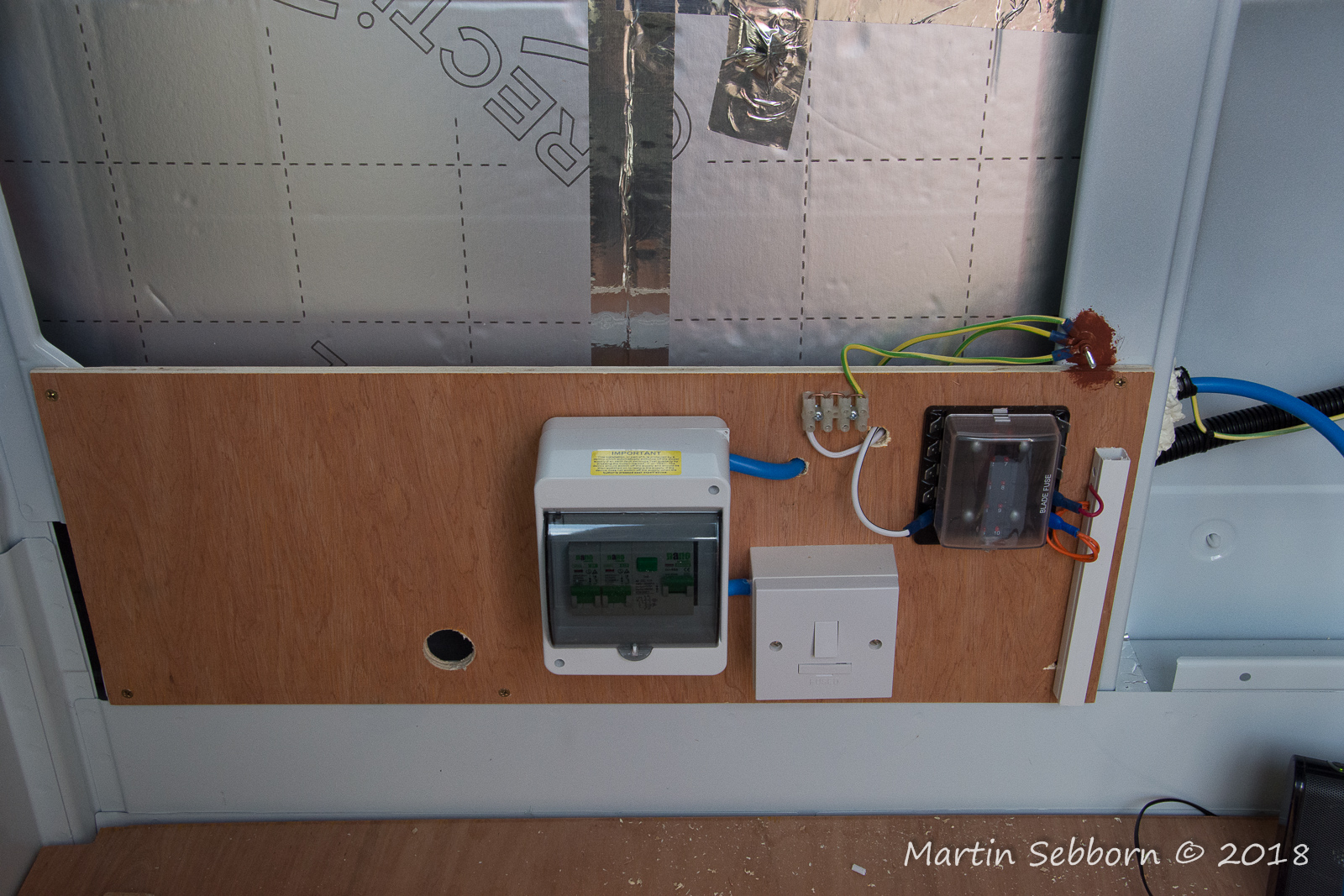 The consumer unit is fitted. The switched spur is for the battery charger. I have also fitted a 10-way fuse holder and started running in wires for lights, etc. It is very important to earth the consumer unit to the van body.
Posted: 20-Apr-2018 | Category: General
Trimming the rear door cards
The majority of self builds (and factory builds for that matter) use "wallboard" for the wall and ceiling panels. These are typically 3mm plywood covered in either paper or vinyl. Whilst the idea is fine, we struggled to find a finish that we liked - they all look a bit old fashioned for our taste, so we decided on a different approach.
We visited Martim, a vehicle uplholstery and trim specialist in Sandbach. They have an amazing array of materials and colours - and very helpful staff. We selected a Silver Grey vinyl for the main panels - so purchased a sample length to play with. We also purchased a length of brushed nylon headlining to experiment with.
Having tried the materials on test panels, we ordered the necessary quantities to do all the panels in the van, plus headlining. We also chose a slightly darker grey (Saville Grey) vinyl in order to add some contrast.
This will be combined with painted panels to kit out the van. The photo below shows one of the original rear door panels trimmed in the silver grey vinyl.

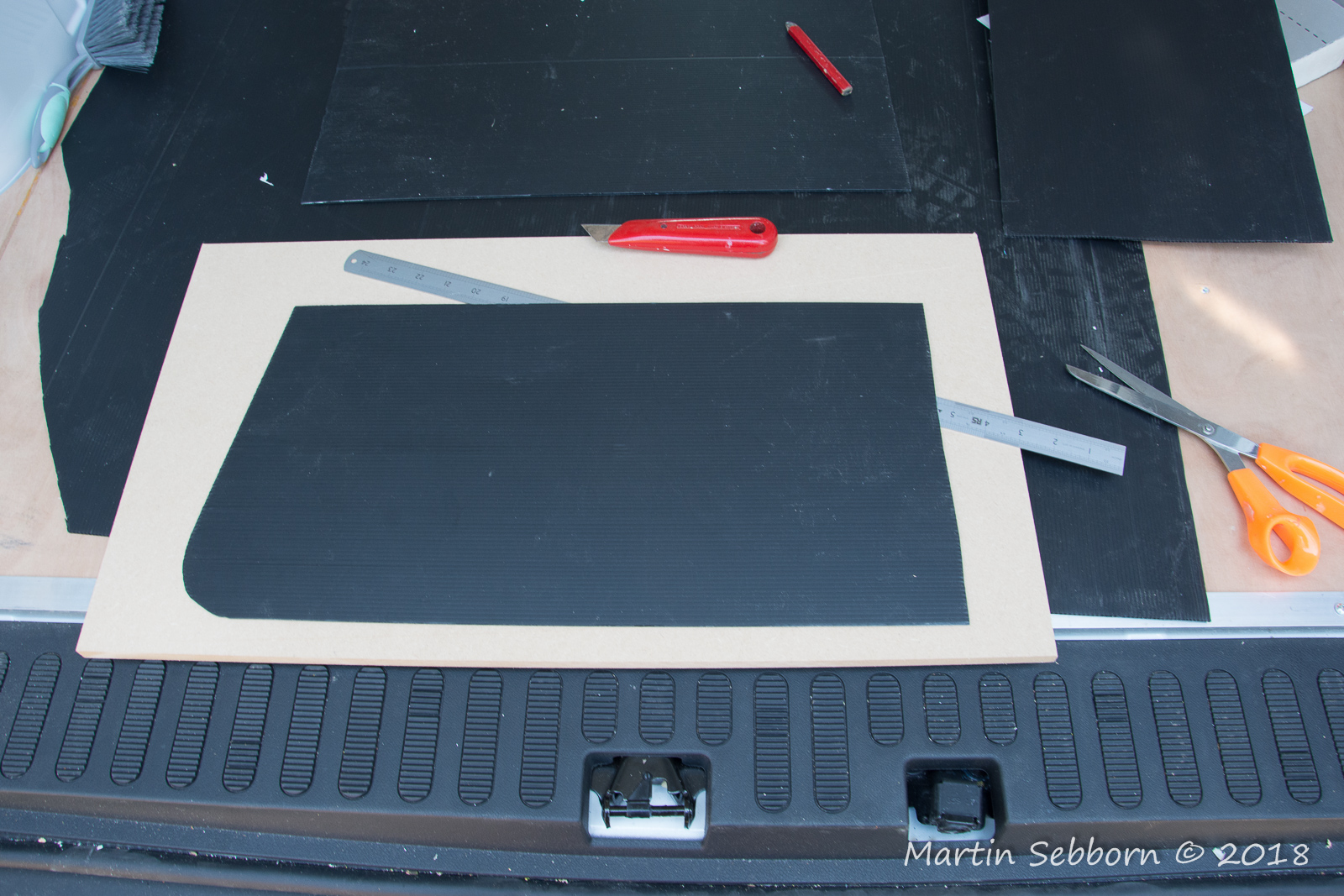
As part of this work I started creating the other panels needed for the rear doors - first making a template using the black protective material mentioned earlier, and then making the ply panel.

Posted: 23-Apr-2018 | Category: General
Windows!
Fitting the windows has to be one of the scarier jobs in a self-build, although this is more about apprehension than the actuality of doing it.
We are going to have 4 windows, and a single roof light. First window!
At this stage I cannot finalise the roof light position as I need the dimensions for the awning and solar panels. So decided to start with the window in the sliding door - lots of people start with this one on the basis that f it goes wrong, you just need a new door!!
Lots of measuring - I made a template using the black plastic protection sheets and used that to position the window and then draw around it. In the case of this window I could cut it from inside which minimised how much masking up was needed. The steps below show the process - once I had measured it again, had a cup of tea, measured it again…..
 The upright bar is to stop the panel moving, so is not structural and can be removed. I marked roughly where it needed to be cut.
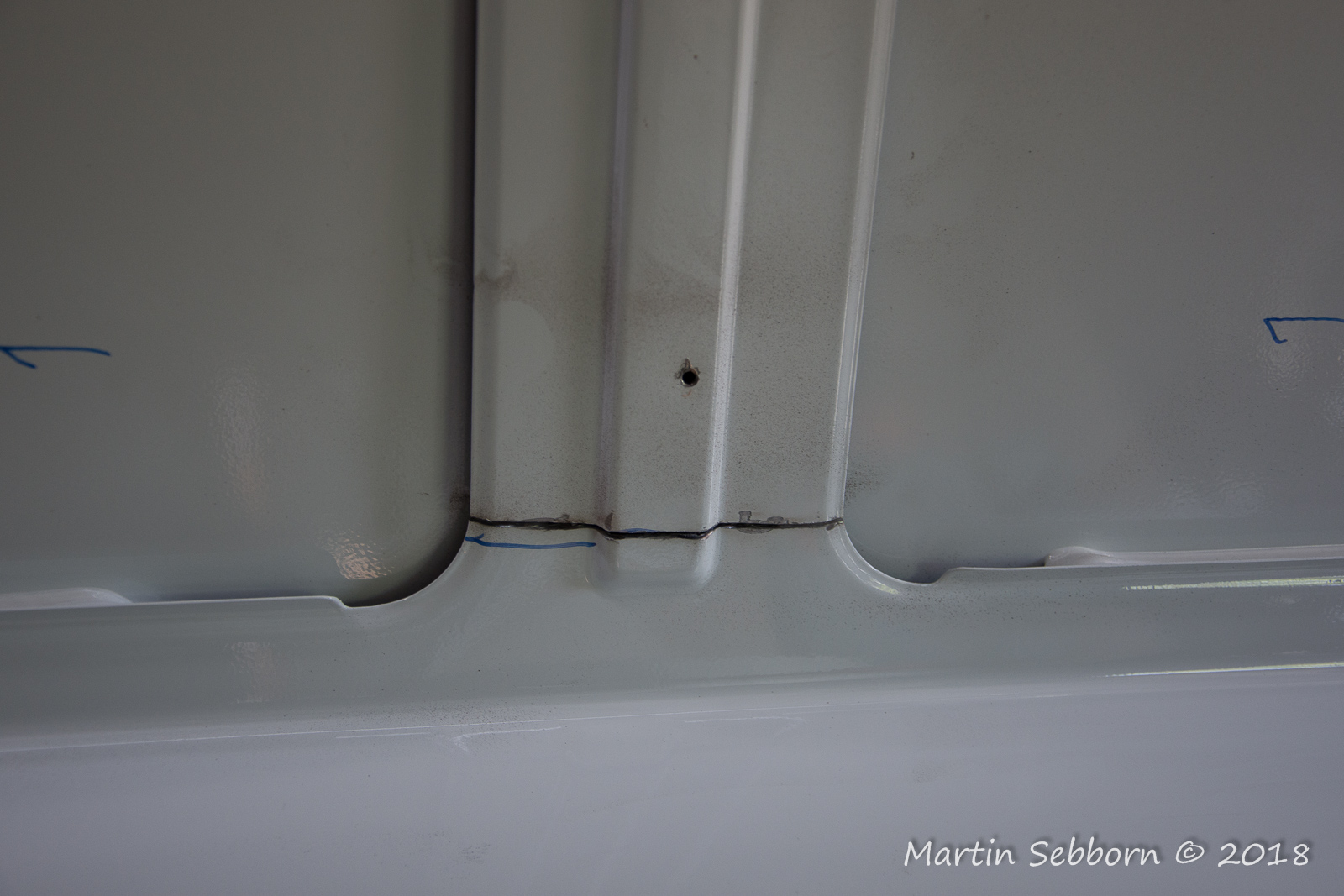 Using a Minicraft (Dremel) drill and cutting disc, I cut carefully through the bar
 Upright removed
 Template in place - check all is in line with the panels, then mark around it
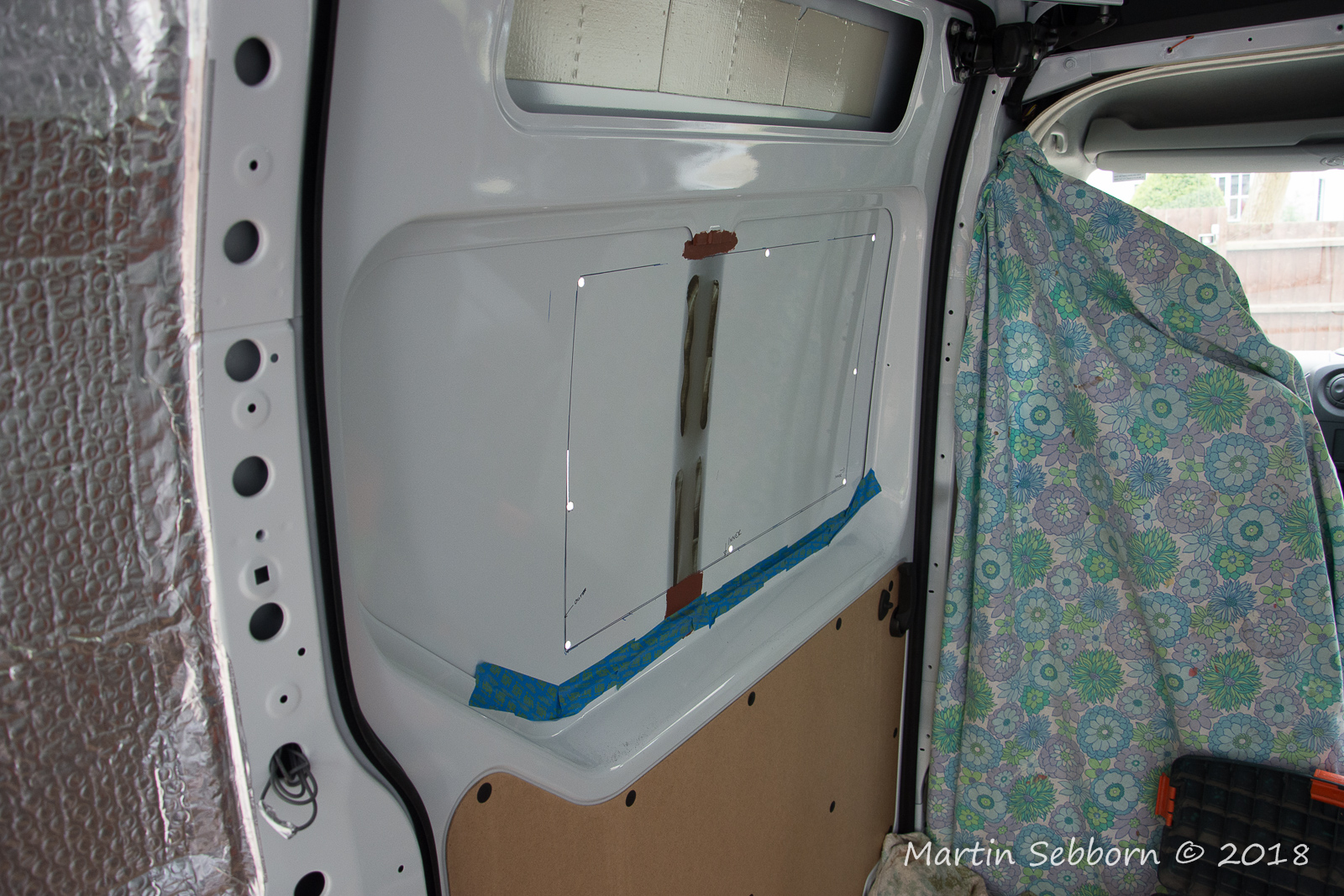 The first step is drilling some holes. I drilled 10mm holes in the corners (successively increasing the drill size, and 10mm holes in the “centre” of the marked lines - the cuts are started from this central either up or down / left or right to the corner holes. The blue tape is to stop metal dust dropping down into the door.
 The cut was made using a new Bosch fine metal cutting blade. I stopped regularly to add tape to stop the panel moving. On the inside I used Duck Tape, masking tape on the outside.
 Taping up the outside
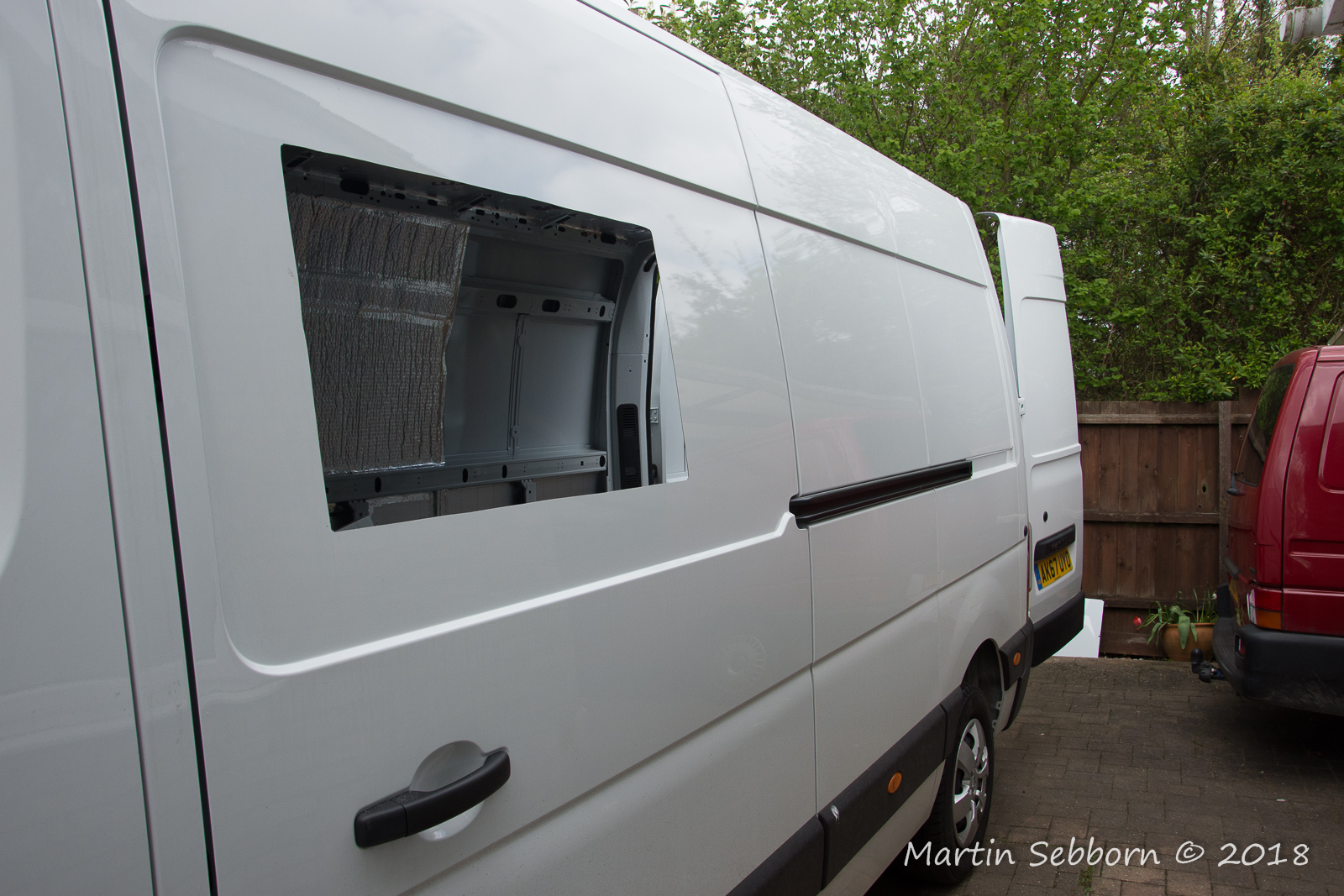 Cutout complete. Using the tape to hold the panel still reduced the vibrations to almost nothing. Don't forget to deburr the cut edges and paint them to stop rust. Also, it is essential to clear up the metal dust from the jigsaw as this will go rusty and damage any paint it is on.
 I had already made up some wooden formers to fit round the cutout - these are made to suit the size of trim panels to be fitted, and are curved to match the van's panel, thus avoiding distortion of the panel. The wooden formers are glued in place using Stixall, and then clamped until set (approx 2 hours in this case).
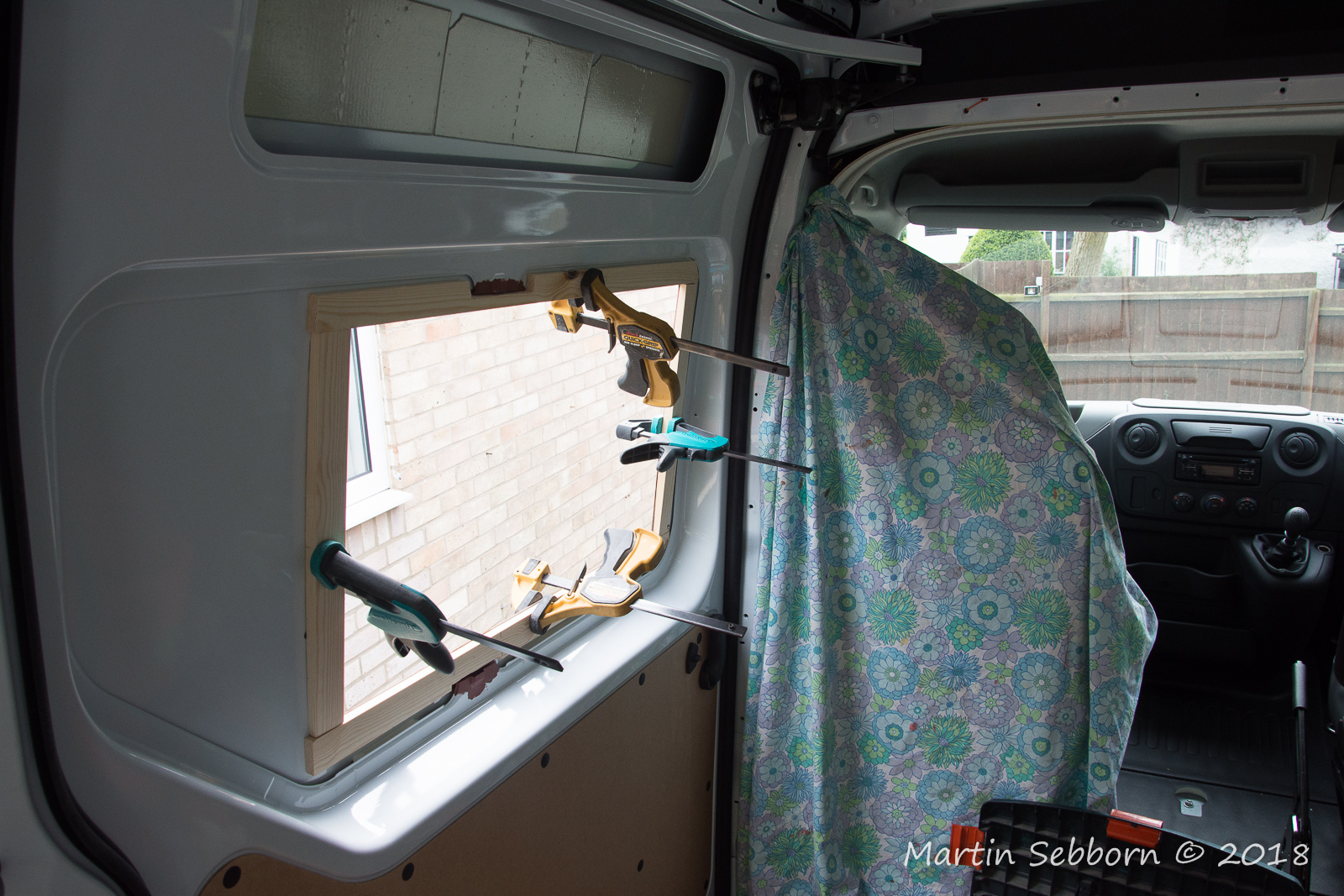 Adhesive dry and clamps removed
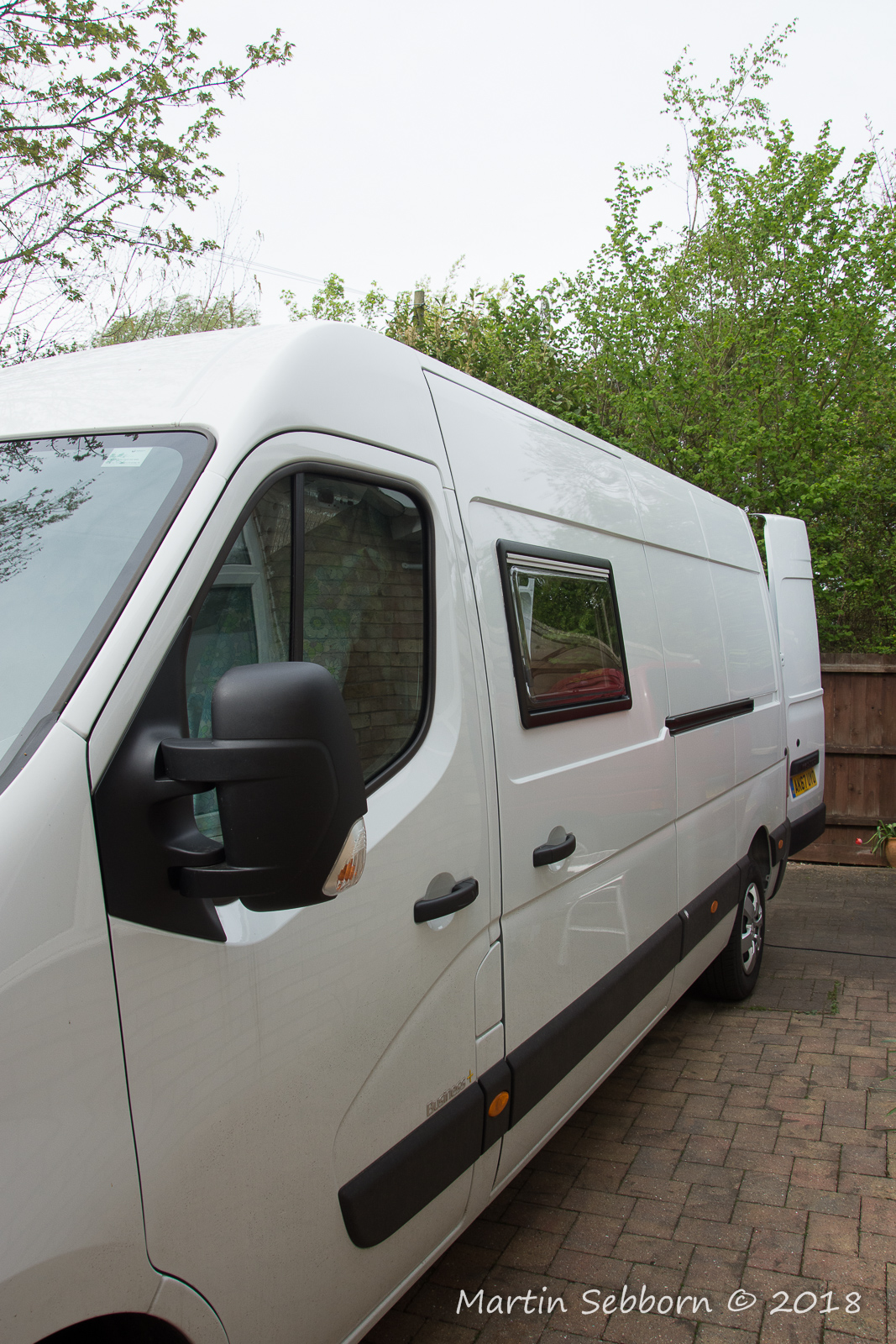 The windows is then fitted - phew!
Posted: 01-May-2018 | Category: General
Seat swivels
Picked up a couple of FASP Seat swivels from Rainbow Conversions. They are easy to fit although the holes did not line up that well and needed a bit of fettling.
The driver's seat swivel fouls the handbrake and so some modification to the handbrake is going to be necessary. The passenger seat swivel works a treat.

Posted: 03-May-2018 | Category: General
Awning
We decided we wanted an awning because:
- somewhere to take off boots if it's raining
- somewhere to cook outside under shelter
We decided on a Fiamma F65 manual model - we couldn't really justify the extra cost of an electric one.
Although a 3.7m version would fit the full length of the van, we decided that we only wanted a 3.2m one, so purchased the following items from Rainbow Conversions:
- Fiamma F65 x 320
- Fiamma fitting kit - Renault Master
The fitting kit comprises three aluminium extrusions, pre-drilled, and various bolts / spreader plates. Some of the holes in the extrusions line up with the roof rack mounting holes already in the roof, the remainder need to be drilled, then primed and sealed as part of fitting the brackets.
The awning itself drops into the brackets fairly easily - although it is tricky working at height with a heavy long lump!
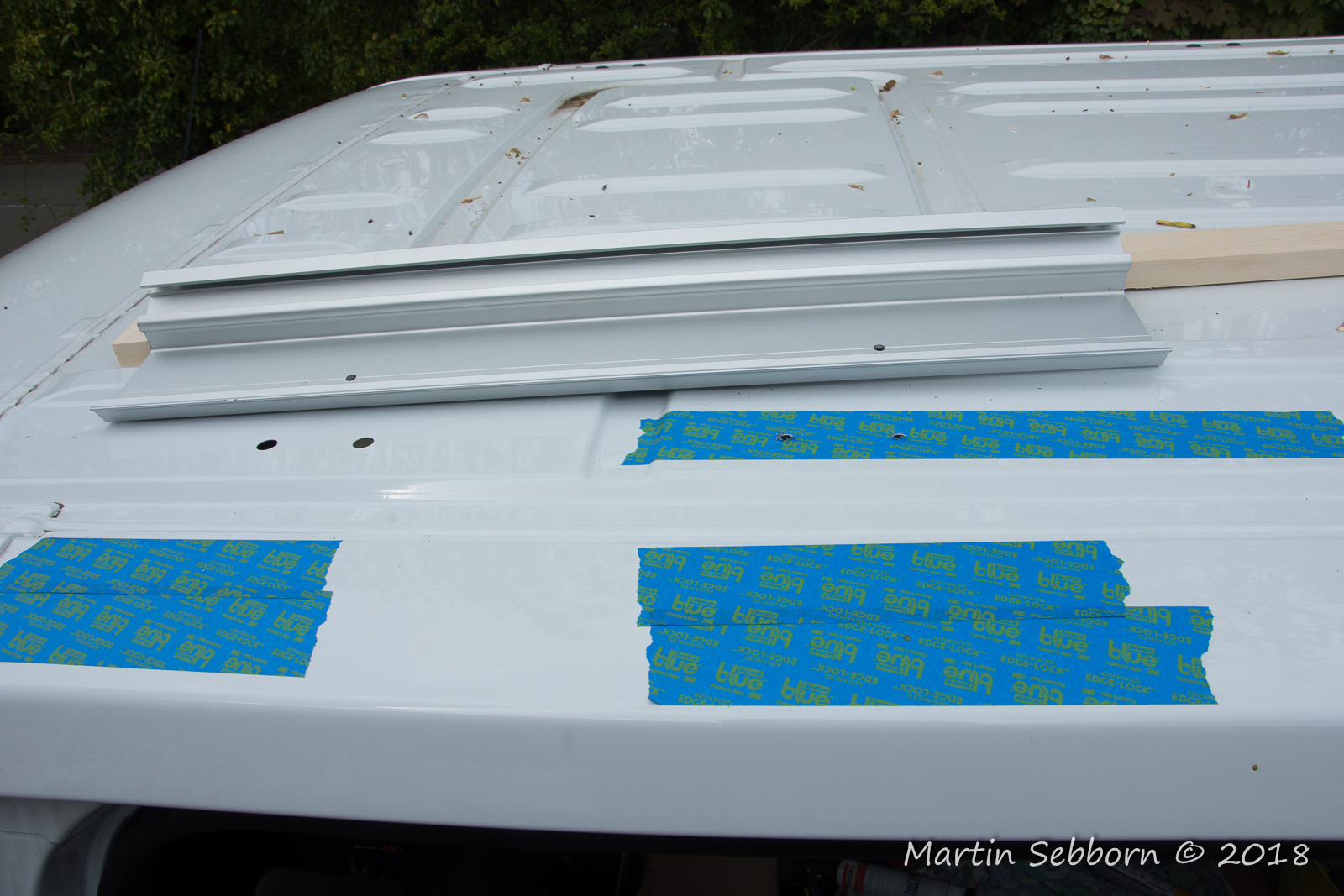 Marking up and drilling the holes see one of the extrusions. I found I had to put packers under the extrusion to then get extrusions level and in line
 The view of the fixings holes inside the van. The lower holes are larger - they are the pre-existing holes for a roof rack.
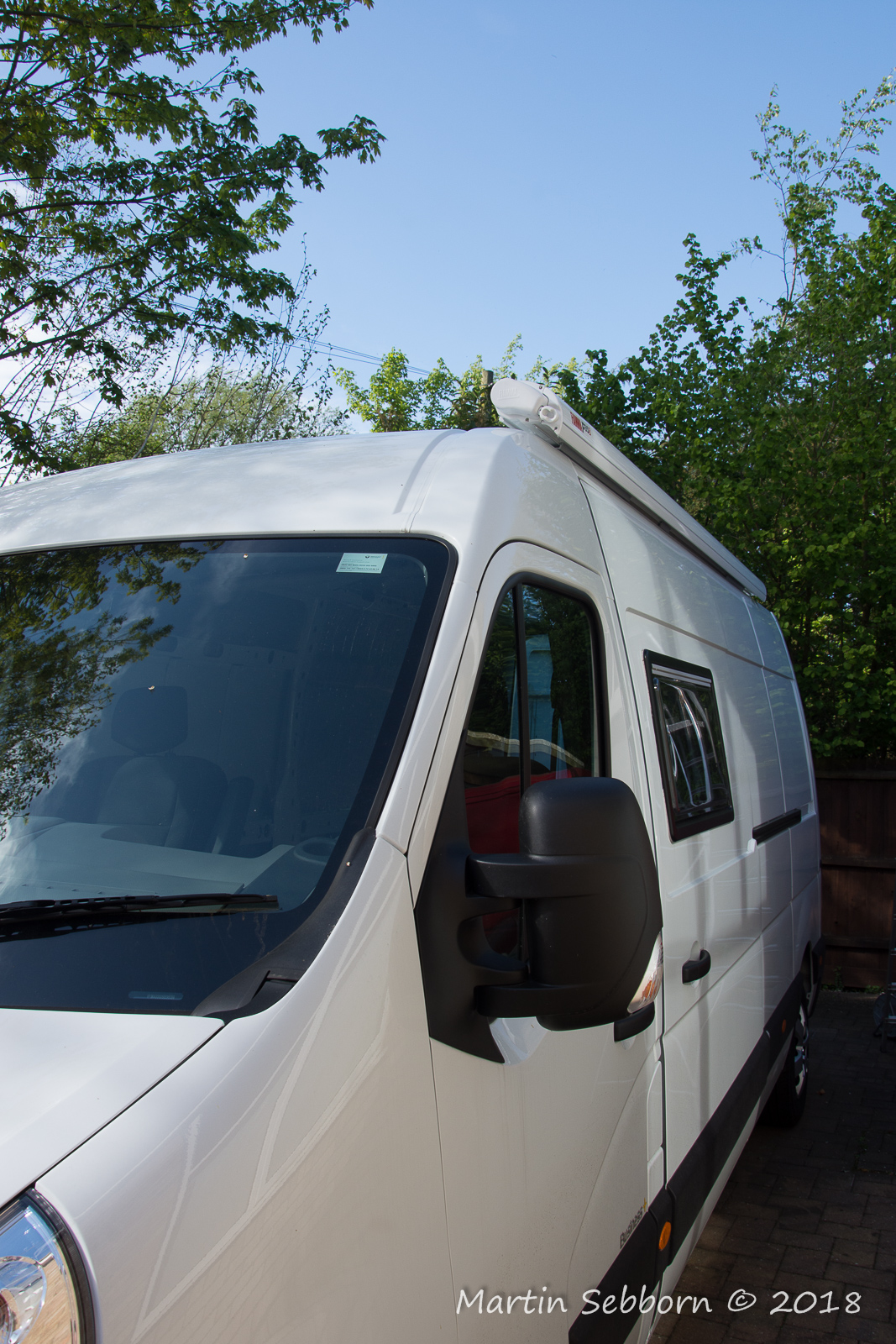 All fitted and ready to go!